After a collision, most drivers focus on getting their vehicle back quickly. Very few stop to ask whether the shop they’ve chosen is actually qualified to handle the repair their vehicle needs. I-CAR certification appears on shop websites and waiting room walls across the country — but not all certification levels carry the same accountability, the same training requirements, or the same outcomes. Choosing the wrong auto body repair shop without understanding this distinction is a mistake that surfaces later: during a resale inspection, a follow-up insurance claim, or a post-collision safety check. The difference between I-CAR Gold Class and standard certification is structural — and it affects documentation, parts standards, and long-term vehicle safety in ways most drivers never anticipate.
What Each Certification Level Actually Requires — And Where the Floor Is
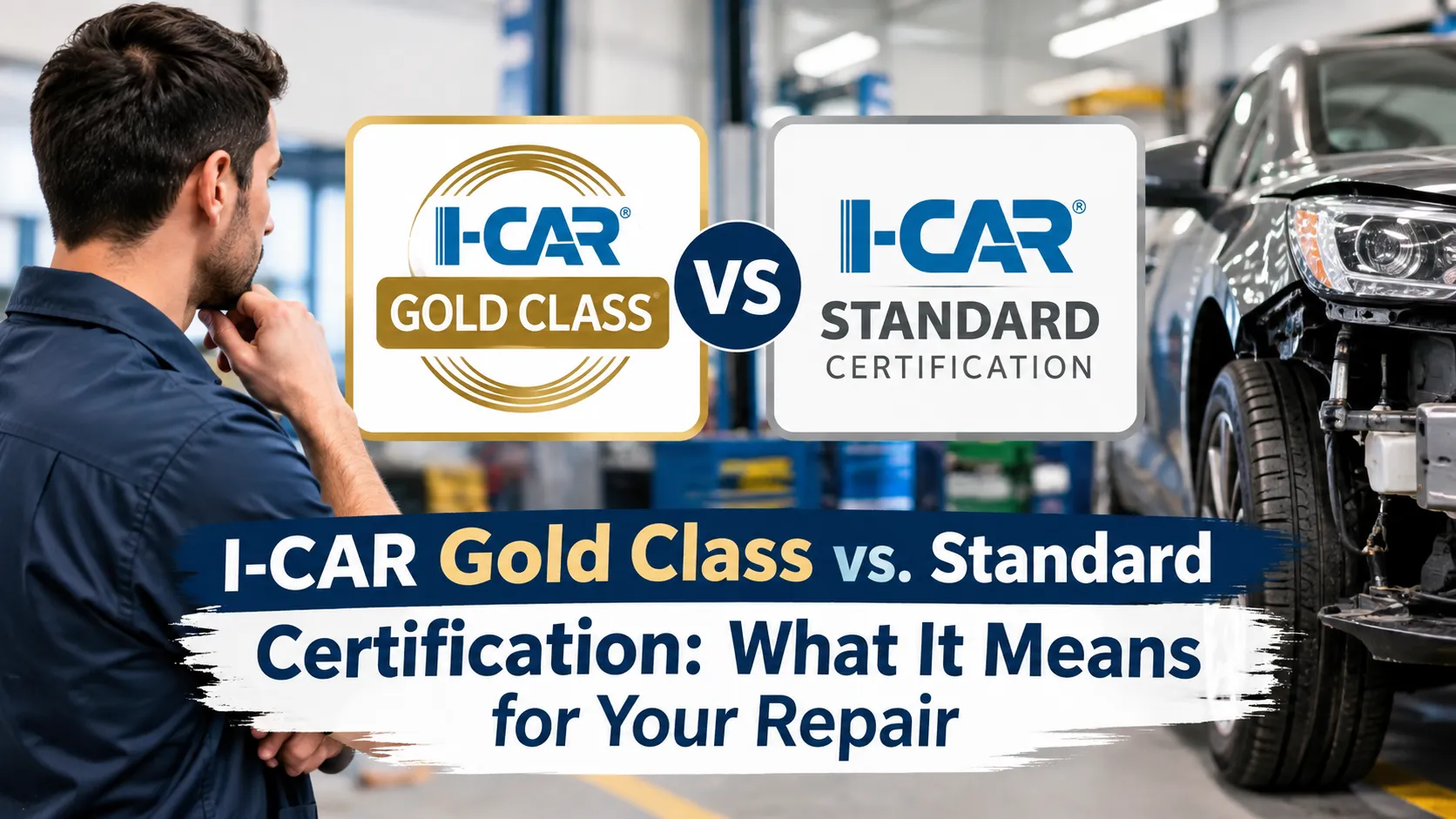
I-CAR Gold Class is a shop-wide designation. Every role within the facility — estimators, structural technicians, refinish technicians — must meet annual, role-specific training benchmarks. It is not a one-time credential. It requires continuous renewal, which means the shop’s competency is actively maintained, not historically claimed.
Standard I-CAR certification operates differently. An individual technician may complete a course and hold a valid credential, but no organizational requirement ties the entire shop to an ongoing training structure. One certified technician does not make a Gold Class facility.
This is the most consequential misconception in the collision repair shop evaluation process: drivers frequently assume that any shop displaying I-CAR materials meets the same standard. It does not. Gold Class is a systems-level commitment enforced across the shop. Standard certification is an individual achievement with no shop-wide accountability structure behind it.
I-CAR publicly documents its role-specific training requirements and maintains a shop locator that distinguishes Gold Class facilities — a resource most drivers never consult before authorizing a repair.
The Four Repair Outcomes That Diverge Between Certification Levels
Documentation and OEM Compliance
Gold Class shops follow OEM repair procedures as a baseline — not an optional upgrade. For modern vehicles built with advanced high-strength steel, aluminum, and integrated sensor systems, manufacturer repair procedures are engineering requirements, not suggestions.
Standard-certified shops are not held to the same procedural discipline at the shop level. Technicians may apply general repair knowledge that deviates from OEM specifications without any systemic check in place. On vehicles manufactured after 2018, where structural geometry and sensor placement are tightly interdependent, this deviation can affect crashworthiness in a subsequent accident — invisible at pickup, measurable in a future safety event.
Non-OEM-compliant repairs can also affect manufacturer warranty standing — a liability most drivers unknowingly assume when choosing a shop based on price or insurer referral alone.
Parts Sourcing and Repair Process Accountability
Gold Class training incorporates parts identification and fitment standards aligned with OEM expectations. Technicians recognize when a part specification matters to structural or safety performance — and source accordingly.
Standard certification does not enforce sourcing discipline at the shop level. Without a shop-wide accountability structure, aftermarket or non-specified parts may be used without the driver’s informed consent. This gap typically surfaces during a resale inspection, a subsequent insurance claim, or a post-collision safety assessment — moments when the original repair decision is no longer reversible.
What Drivers Get Wrong When Comparing Shops
The most common error is treating the I-CAR name as a uniform quality signal. Seeing I-CAR materials in a shop’s lobby does not indicate Gold Class status. The name spans certification levels, and shops are not required to distinguish which level they hold in their marketing.
Insurer referrals compound this problem. Direct Repair Program networks do not require Gold Class status for inclusion. A driver directed to a recommended auto body shop by their insurer may be sent to a standard-certified facility with no disclosure of the difference. The assumption that insurer-preferred means thoroughly vetted is widespread and incorrect.
The practical consequences are not theoretical — calibration failures on ADAS-equipped vehicles, panel fitment issues flagged during resale, and repair documentation gaps that complicate subsequent claims all trace back to certification-level differences. Every one of those costs lands on the vehicle owner.
The comparison between Gold Class and standard certification is not about reputation. It is about whether the shop’s accountability structure matches the complexity and safety requirements of the repair being authorized.
How to Use This Comparison Before You Authorize Any Repair
Before signing any repair authorization, three verifiable checkpoints take under ten minutes and eliminate the most common sources of post-repair disputes.
First: Confirm Gold Class status independently. I-CAR maintains a public shop locator at i-car.com that identifies Gold Class facilities by location. Do not rely on a shop’s self-representation — verify directly.
Second: Ask explicitly whether OEM repair procedures will be followed for your vehicle’s specific make, model, and year. A qualified auto body repair shop will answer this without hesitation. Vague responses about “industry-standard practices” are worth noting.
Third: Request written documentation confirming which technician roles will be involved and whether each holds current, role-relevant I-CAR training. A Gold Class shop will have the records to support this without pushback.
For any vehicle equipped with active safety systems — lane assist, automatic emergency braking, adaptive cruise — add a fourth checkpoint: confirm whether post-repair ADAS calibration is included and performed by trained personnel. This is where the gap between certification levels becomes a direct safety issue. Any autobody repair near me search may return shops that are not equipped to perform this step correctly — and that gap is rarely disclosed upfront.
The authorization conversation, not the pickup conversation, is where repair quality is decided.
Trust the Shop Whose Certification Does the Talking
At Spectrum Auto Inc., I-CAR Gold Class certification is not a wall decoration — it is the operational standard every repair is held to. Serving West Nyack, Rockland County, and surrounding New York communities, Spectrum Auto combines Gold Class-trained technicians with OEM repair procedures, proper parts sourcing, and post-repair ADAS calibration on every qualifying vehicle. When you bring your vehicle to a collision repair shop that maintains this standard, you are not hoping the repair was done correctly. You have the documentation, the trained personnel, and the accountability structure to confirm it. Visit Spectrum Auto Inc. before you authorize your next repair.
Frequently Asked Questions
- Does every shop that mentions I-CAR training qualify as Gold Class?
No. I-CAR training is available to individual technicians at any shop. Gold Class is a separate, shop-wide designation requiring every role — estimators, structural and refinish technicians — to meet annual training benchmarks. A shop can employ I-CAR-trained individuals without holding Gold Class status.
- Will my insurer’s preferred shop always be Gold Class certified?
Not necessarily. Direct Repair Program networks do not require Gold Class status for inclusion. Always verify a shop’s certification level independently using I-CAR’s public shop locator before authorizing any repair through an insurer referral.
- How does certification level affect my vehicle’s resale value or warranty?
Repairs performed outside OEM specifications — more common at non-Gold Class facilities — can be flagged during resale inspections and may affect manufacturer warranty standing. Gold Class shops follow OEM procedures as a baseline, protecting both structural integrity and the vehicle’s documented repair history.
- Is ADAS calibration included at standard-certified shops after a collision repair?
Not consistently. Post-repair ADAS calibration requires role-specific training that Gold Class shops maintain through their certification structure. Standard-certified shops have no organizational requirement ensuring this step is performed correctly — leaving drivers of sensor-equipped vehicles exposed to a safety gap rarely disclosed upfront.