
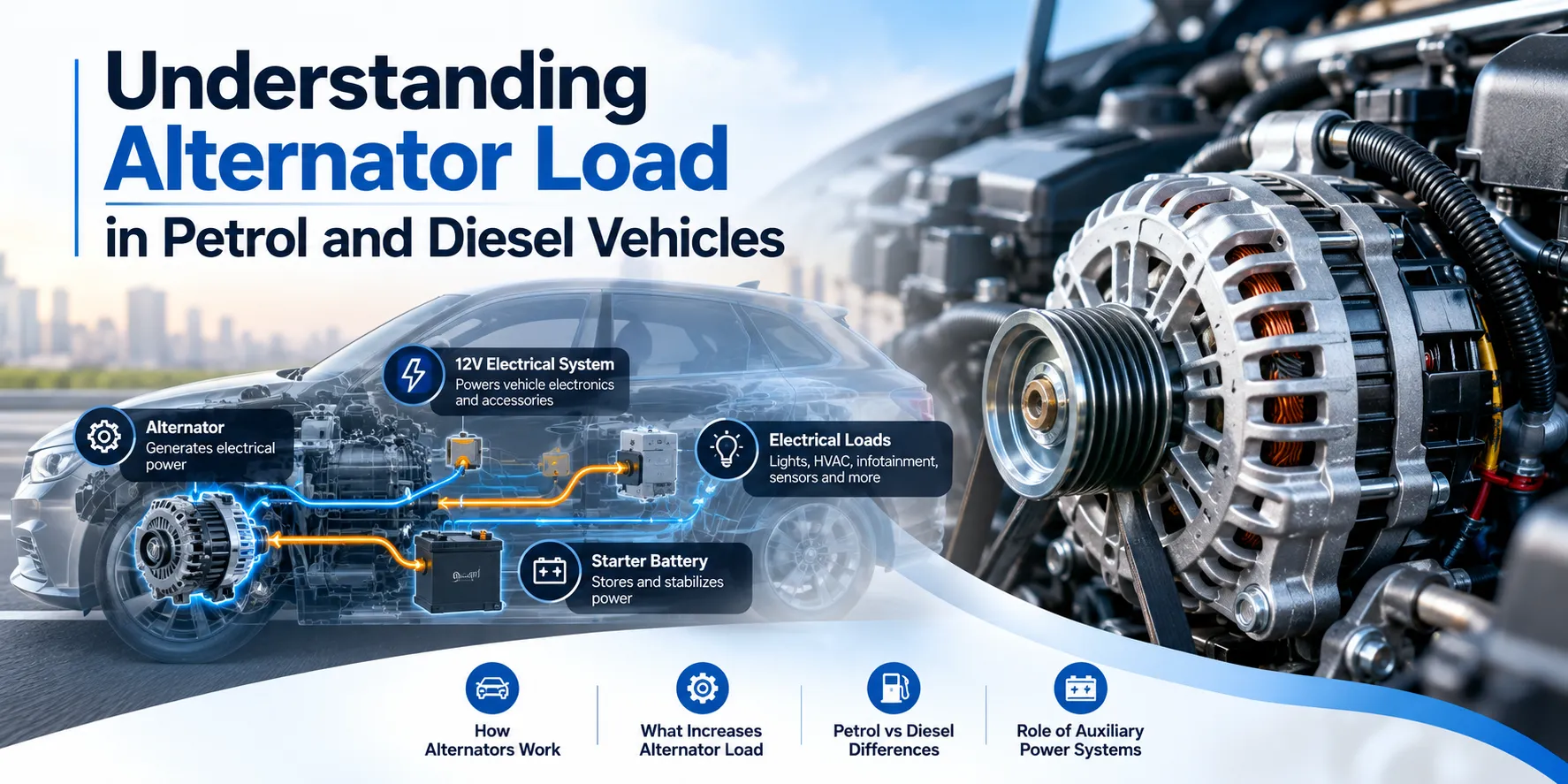
A vehicle’s alternator does more than recharge the starter battery. It is a key part of the 12V electrical system, supplying power to lights, control modules, infotainment, ventilation, sensors, pumps, and other electrical equipment while the engine is running. The amount of electrical power demanded from the alternator is commonly described as alternator load.
Understanding alternator load in cars helps explain how electrical accessories affect the vehicle’s energy system and why electrical demand can influence the mechanical work required from the engine. This is particularly relevant as conventional petrol and diesel vehicles increasingly carry more electrical equipment.
The basic principle is straightforward: when electrical demand rises, the alternator has to generate more electrical power. That generation requires mechanical input from the engine through the accessory drive system.
What Is Alternator Load in a Car?
Alternator load refers to the electrical demand placed on an automotive alternator while it is operating.
An alternator converts mechanical energy from the running engine into electrical energy. That electricity supports the vehicle’s 12V electrical network and, depending on operating conditions, replenishes energy stored in the starter battery.
The actual load varies continuously rather than remaining constant. A car cruising during daylight with limited electrical equipment switched on may require relatively little alternator output. Turning on headlights, climate-control equipment, heated systems, additional accessories, or other electrical consumers increases the demand.
The vehicle electrical system therefore operates as a dynamic energy network in which generation and consumption change according to driving conditions and electrical requirements.
How Does an Automotive Alternator Handle Electrical Demand?
An automotive alternator is mechanically driven by the engine, typically through a belt and pulley arrangement. Inside the alternator, rotational mechanical energy is converted into electrical energy.
A voltage regulator controls alternator output so that the vehicle’s electrical system remains within an appropriate operating range. The alternator does not simply produce its maximum possible output at all times. Its output responds to electrical demand and the vehicle’s charging strategy.
Why Higher Electrical Demand Matters
When the electrical load increases, the alternator generally needs to produce more current. Producing that additional electrical output requires additional mechanical torque at the alternator shaft.
That torque ultimately comes from the engine.
This creates an important relationship between vehicle alternator load and the engine’s energy requirements. The electrical equipment itself may consume electricity, but the energy supplied by a conventional alternator originates mechanically from the engine.
The relationship is not perfectly represented by a simple one-to-one calculation because alternator efficiency, operating speed, temperature, regulation strategy, battery state of charge, and other system conditions affect actual energy flows.
Petrol vs. Diesel Vehicles: Is Alternator Load Different?
The underlying electrical principle is similar in petrol and diesel vehicles. Both can use an alternator to supply the conventional 12V electrical system and maintain the starter battery.
The difference is more closely related to the vehicle’s engine, accessory system, electrical architecture, operating conditions, and equipment specification than to the fuel type itself.
A diesel commercial vehicle, for example, may have substantial electrical requirements because of its equipment and operating environment. A petrol passenger car may have a different electrical profile based on its accessories and vehicle architecture.
Consequently, alternator load should be assessed from the actual electrical demand of the vehicle rather than assuming that petrol or diesel automatically determines a particular load level.
What Increases Vehicle Alternator Load?
Several factors can increase electrical demand on a conventional vehicle. Examples include:
-
Headlights and exterior lighting
-
Cabin ventilation and climate-control equipment
-
Heated seats, mirrors, or windows
-
Infotainment and communication systems
-
Electric pumps and fans
-
Electronic control units and sensors
-
Added fleet or commercial equipment
-
Aftermarket electrical accessories
Commercial vehicles and urban delivery fleets can be particularly interesting from an energy-management perspective because vehicles may spend long periods operating with additional electrical equipment while travelling through stop-start environments.
For engineers and fleet operators, understanding the vehicle’s electrical profile can therefore be useful when assessing accessory loads and overall energy architecture.
Can an Auxiliary Battery Change the Energy Flow?
An auxiliary battery provides another place where electrical energy can be stored and supplied to electrical loads. The operating strategy depends on how that battery is charged and integrated with the vehicle’s electrical architecture.
The concept behind auxiliary power systems is relevant here because an auxiliary source can potentially supply electrical demand without requiring every watt-hour consumed by the 12V system to be generated by the alternator at that moment.
Nulldraw is an automotive engineering design in development based on a related concept. The proposed system is intended to use a grid-charged auxiliary battery to supply a conventional petrol or diesel vehicle’s 12V electrical system, allowing the alternator to idle under suitable operating conditions. The engine, alternator, and starter battery remain in place.
This should be understood as a proposed vehicle-energy architecture rather than a commercially available product. Actual performance, efficiency, integration requirements, and vehicle-specific outcomes would need to be established through appropriate engineering development and testing.
Practical Considerations for Vehicle Energy Management
Alternator load is only one part of the wider vehicle energy system. Engineers must consider battery capacity, charging behaviour, alternator characteristics, wiring, protection, thermal conditions, electrical loads, control strategies, and compatibility with the vehicle’s existing architecture.
For retrofit engineering, integration is especially important. Adding an electrical source or changing how loads are supplied cannot be treated simply as connecting another battery. The electrical system must be designed around appropriate voltage management, protection, charging, isolation, and operating conditions.
Fleet operators can also benefit from identifying when electrical demand is highest. Vehicles that spend significant time idling, operating auxiliary equipment, or completing repeated urban routes may have a different energy profile from vehicles primarily used for steady highway driving.
Future Considerations for Conventional Vehicle Electrical Systems
As conventional petrol and diesel vehicles remain in service, managing their electrical energy efficiently will continue to be an engineering consideration. Modern vehicles already depend heavily on electrical systems, while commercial and specialist vehicles can carry additional loads for operational equipment.
This makes the separation between electrical consumption and electrical generation an interesting area for automotive engineering development.
Concepts such as Nulldraw explore whether a grid-charged auxiliary energy source could support selected 12V electrical loads while reducing the need for the engine-driven alternator to provide that electrical power at the same time. Because the design remains in development, its practical implications should be considered as an engineering proposition rather than an established production solution.
Conclusion
Alternator load in cars is fundamentally the electrical demand placed on the alternator as it supplies the vehicle’s 12V system and supports battery charging. When electrical demand increases, the alternator generally requires greater mechanical input from the engine to generate the additional electrical power.
The principle applies to both petrol and diesel vehicles, although actual electrical loads depend on vehicle design, accessories, operating conditions, and energy-management strategies.
Understanding this relationship provides a useful foundation for evaluating conventional vehicle energy systems. It also helps explain why auxiliary electrical architectures are being explored. Nulldraw represents a design in development that is intended to investigate how a grid-charged auxiliary battery could supply a conventional vehicle’s 12V electrical system while leaving the existing engine, alternator, and starter battery in place.